

If you run a construction business in Brisbane, Gold Coast, or Sydney and your marketing is not generating consistent work, you are not alone. You are probably not doing anything wrong either. The problem is almost never effort. It is strategy. Most marketing advice aimed at construction companies was written by generalist agencies who have never sold a $500k renovation or tendered a civil contract in their lives.
This article is written for business owners doing serious revenue who are tired of paying for marketing that looks busy but fills nothing in the pipeline.
Why Most Construction Marketing Fails
The number one reason construction marketing fails is that it treats a high-trust, high-consideration purchase like a fast-moving consumer product.
You are not selling coffee. When a developer is deciding who gets a $200k contract, they are not clicking add to cart.
The second problem is inconsistency. Most construction businesses market in bursts. They push hard when the pipeline is thin, then go quiet when jobs fill up, then panic six months later when work dries up again. Leads in construction have long sales cycles. The buyer who sees your content today might not call for three months.
The third problem is channel mismatch. Builders, roofers, civil contractors, and demolition companies all have different buyers with different behaviours. Most agencies apply the same template to all of them and wonder why neither converts.
What Construction Buyers Actually Do Before They Call You
Understanding this changes everything about your marketing strategy. Before a serious buyer picks up the phone, they have almost certainly done the following:
- Searched your business name and looked at your Google reviews.
- Visited your website and formed an opinion within eight seconds.
- Looked for evidence of completed work: photos, videos, case studies.
- Checked whether you look like the kind of operation they can trust with their project.
- Looked at your LinkedIn or Instagram to see if the business is active and professional.
At no point in that process did they care about your tagline or your commitment to quality. They are looking for proof. Your marketing job is to exist visibly in the right places, and to show, not tell, that you deliver. That is a content and credibility problem, not an advertising problem.
The Marketing Channels That Work for Construction in Australia
Not every channel is worth your time or money. Here is what actually moves the needle for Australian construction businesses in 2026. The order matters.
Before Google, before social, your business is now being discovered through AI. Gemini indexes YouTube videos directly. Instagram content is surfaced by AI-powered search. ChatGPT and Perplexity pull from websites, directories, and structured content. If your business does not appear in AI-generated answers, you are invisible to a growing segment of buyers who never open a search engine. This is the most important channel to get right in 2026.
Construction is a search-driven category. Ranking organically builds long-term, compounding lead flow. Paid search fills the gap while you build authority.
For businesses targeting residential or SME commercial clients, your GBP is often the first thing a buyer sees. Reviews and photos matter more than most realise.
For civil contractors and demolition companies working with developers or project managers. Content that demonstrates expertise builds awareness with exactly the right audience.
Still relevant for residential builders and renovation companies, particularly in Gold Coast and Sydney. The content needs to show finished work and real projects.
Consistently underrated. A regular email to past clients, referral partners, and warm leads keeps you front of mind without requiring ad spend. The lowest-cost retention and referral tool available.
Consistent, strategic social media is not about vanity metrics. For construction businesses, it does several things at once that no other channel can replicate.
SEO authority. Regular content output signals to Google that your business is active and relevant. Social shares and links from platforms contribute to your domain authority over time.
Proof of life. A buyer checking you out in 2026 expects to see recent activity. A dormant Instagram or LinkedIn profile tells them the business may not be operational, or worse, does not care.
Category authority. Businesses that post consistently about their work, their process, and their expertise become the recognised authority in their niche. That recognition compounds. You stop competing on price because buyers have already decided they want you.
AI discoverability. This is the biggest shift happening right now. Gemini surfaces YouTube videos in AI overviews. Instagram Reels are being indexed and served by AI assistants. Consistent content means your business appears when AI tools answer buyer questions, without paying for a single ad.
What does not work: one-off campaigns, boosted posts with no strategy behind them, and lead generation forms that go cold because there is no follow-up system.
Video Content: Why It Works Harder Than Any Other Format
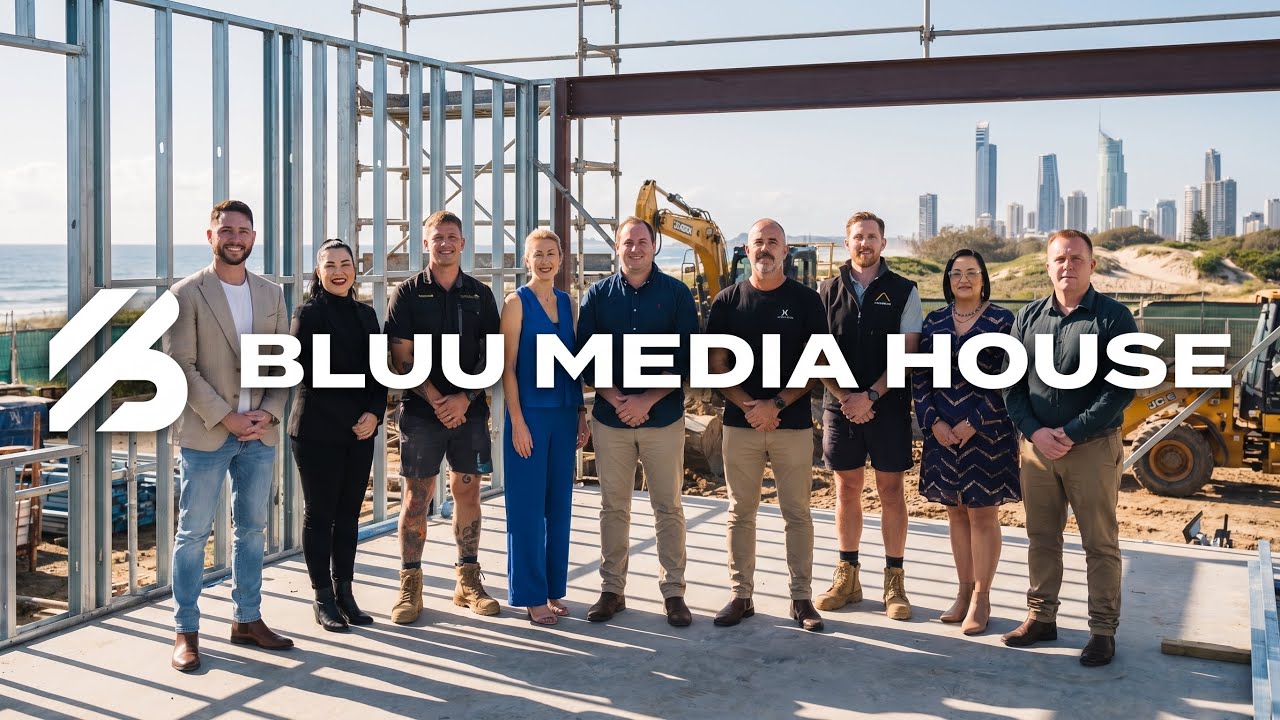 Watch the Brand Film
If there is one investment that has the highest return for construction marketing right now, it is video. Construction is inherently visual. The work you do is compelling: the scale, the transformation, the craft.
"I watched your video and knew I wanted to call you." That is not something a static website achieves.
A two-minute brand film of a completed commercial build does more for your credibility than a year of social media posts. A case study video that walks through a project, the challenge, the solution, and the outcome, gives a prospective client everything they need to imagine working with you.
Video also performs better across every channel where construction buyers are active. It stops the scroll on Instagram. It builds authority on LinkedIn. It increases time on page on your website. When combined with AI-assisted production workflows, construction businesses can now produce a consistent volume of high-quality content at a fraction of the cost of three years ago.
How to Get More Leads Without Wasting Money
If you want to get more leads for your construction business, the answer is not more spend. It is a better system.
Your website needs to load fast, look professional on mobile, and show real evidence of your work. If it does not, no amount of advertising will overcome the drop-off.
Get your Google Business Profile fully built out with current photos and a process for collecting reviews from every completed project. This costs nothing but time.
What does a $500k renovation actually cost? How long does a commercial fitout take? Content that answers these questions builds organic search traffic and positions you as the credible expert.
Most construction leads do not convert immediately. If you have no system to stay in contact: an email sequence, a retargeting campaign, a regular newsletter, you are losing warm leads to competitors who do.
If you cannot tell which channel brought in your last five enquiries, you are managing marketing blind. Basic tracking is non-negotiable.
What a Good Construction Marketing System Looks Like
A functioning construction marketing system has several components that work together rather than in isolation.
Strong brand identity. A clear articulation of what you do, who you do it for, and why a buyer should choose you over every other option. This clarity flows into every piece of content, every ad, and every pitch.
A content engine. A regular output of video, written content, and social proof that demonstrates expertise and builds trust over time. Not a campaign. An ongoing system that runs whether you are busy or quiet.
A lead generation layer. The channels and campaigns that bring new buyers into contact with your business, targeted to the right locations and buyer types.
A follow-up and nurture process. Every lead, every enquiry, and every past client is kept in contact until they are ready to move or refer someone who is.
When all of these components are functioning, the pipeline becomes predictable. Not a great month followed by a drought. Consistent, qualified enquiry that lets you choose the right jobs instead of taking everything that comes in.